
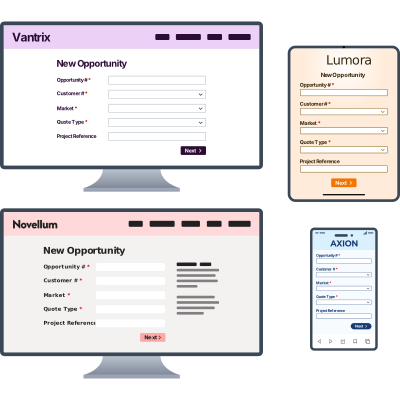


Regardless of where you're starting, important questions need clear and consistent answers sooner rather than later, such as:

If every AI-built application answers those questions differently, speed turns into sprawl, security risk, and costly complexity. A weak intake foundation can expose sensitive data, break compliance, and create consequences your team can't afford to discover later.
And then...
Build a form in Form.io, and you are also defining the rules, connections, and experiences around that data. That single definition gives you:

When the form schema changes, the application contract changes with it. Developers, AI agents, business users, and backend services stop working from separate versions of the truth.


You tell your AI what the application needs to do. Form.io gives it the foundation to build on without improvising your data model, routing, and governance patterns.
Direct, governed access from any MCP-compatible AI coding agent into your self-hosted Form.io deployment. Forms, resources, actions, APIs are all reachable without leaving your security boundary.

Platform-specific guidance teaches AI agents how to build on Form.io so standardized, governance-ready patterns get applied by default instead of recreated prompt by prompt.

The Form.io plugin for Claude Code brings the MCP Server and Skills directly into your coding environment so agents build complex form-based applications on the Form.io foundation.
UAG governs the agentic workflows that run after the code ships with dynamic context, guardrails, and data access for AI agents in production.

Governs the form, the API, the validation, the workflow, and the audit trail across every team and every agent.

AI access remains inside your security boundary so your data doesn't leaves your environment unless you explicitly want it to.

Extensible, customizable, and free from vendor lock-in that's adopted by thousands of developers.

For forms, APIs, workflows, data resources, submission pipelines, authentication, and permissions that's not a rip-and-replace platform so it works with your legacy systems.
For most teams it forces a choice: a static fillable PDF with no intelligence, or a dynamic web form that can't produce the document anyone will actually accept. So they build both. And maintain both. Forever.

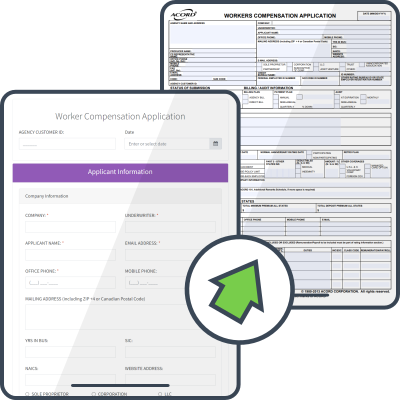
Any Form.io form can render its submission as a clean, downloadable document with no extra build and no separate PDF tool. The form you already designed becomes the record compliance keeps.
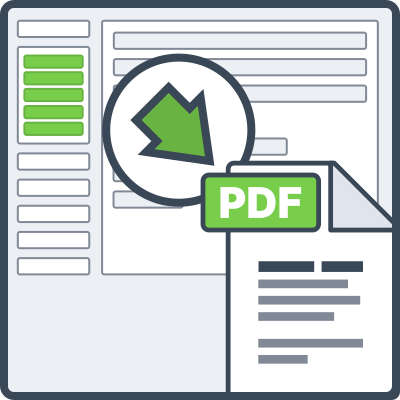
With the PDF Template Designer, output only the fields that matter, in the layout your standards require. A 50-field application becomes a one-page receipt, a formatted contract, or an executive summary, drawn from the same submission, shaped for its audience.

Upload an existing fillable or scanned PDF and Form.io converts it into a live, dynamic form that preserves every field, position, and label. Users complete it as a responsive web form or directly on the pixel-perfect original with the intelligence you need underneath it.
And every new office, team, or workflow variation becomes another ticket your team has to own.
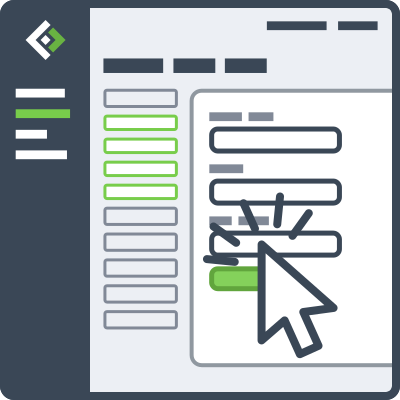

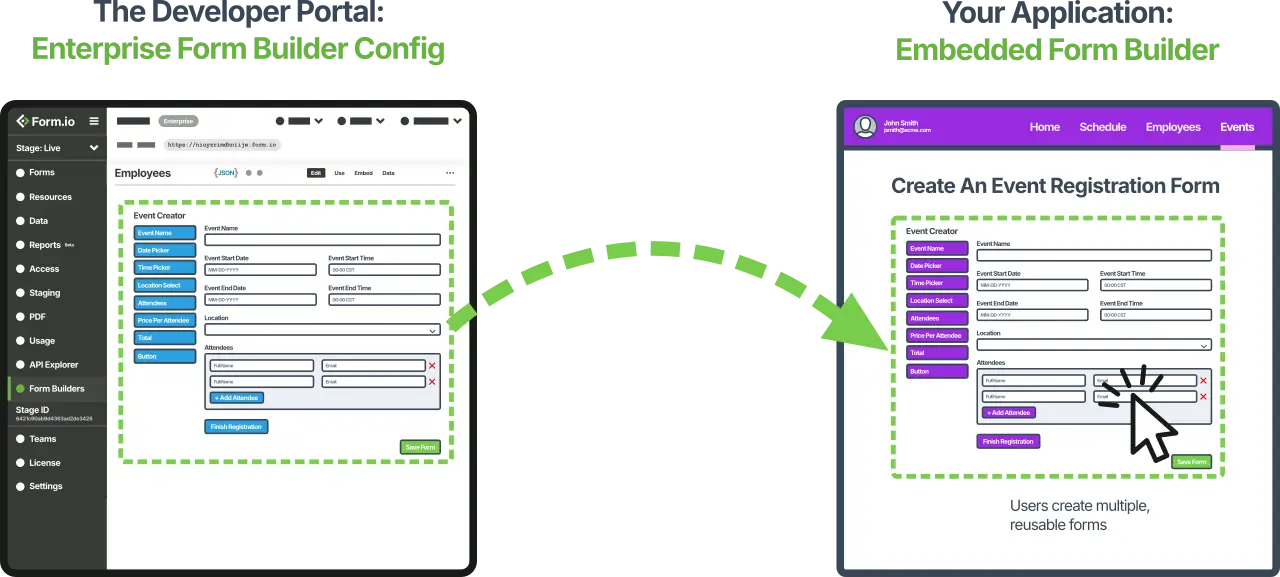
Pre-configure components, constrain what can be built, and keep your branding. Customers self-serve without ever touching your governance.
Every form they build stays tied to Form.io's JSON data model, APIs, and permissions so downstream automation and agent workflows stay reliable.

Form creation moves out of your support queue and becomes a product capability. You grow by configuration instead of hiring or spinning up armies of agents that have to be tracked.

You collect rich submission data, export it to CSV, and hand it to an analyst who opens it in Excel, builds a chart, and ships a snapshot that's stale the moment the next form submission comes in.

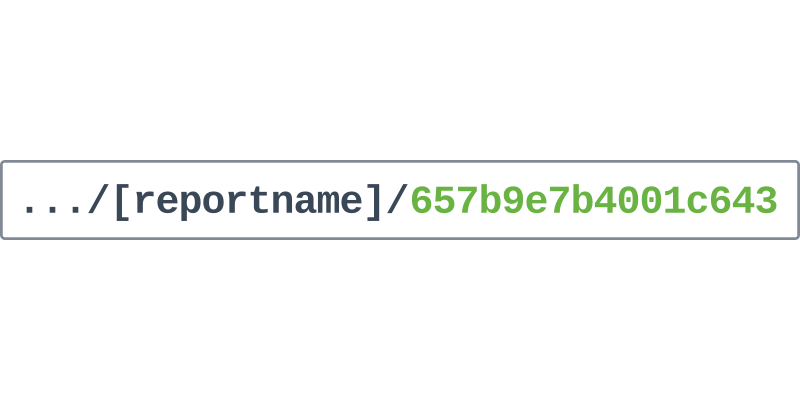
Join data across forms, add calculated columns, and aggregate by group through a visual interface with the full power of MongoDB's aggregation pipeline without hand-writing a line of it. Your developers and admins build and maintain reports with drag-and-drop; no separate analytics team required.
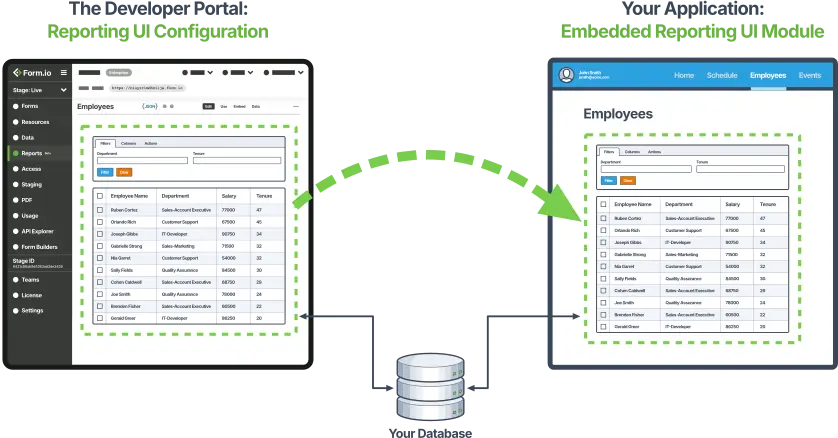
A finished report isn't a file you export, but a UI module. Drop it into your application and your users get an interactive grid: pagination, sorting, filtering, column controls, and export, all in context.
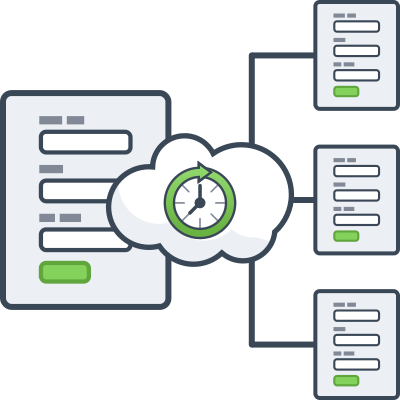
Reports read straight from your database, so new submissions appear automatically without a rebuild or export. Users can edit in context, and reports can emit actions or redraw themselves in response to events happening elsewhere in your app.

Which means your proof of agreement drifts away from the system where the real data lives, and sensitive workflows leave your security boundary just to get signed.


The signature binds to the actual fields, form revision, and submission context...not a document artifact. Tamper with any of it, and validity breaks automatically.
Signing runs inside your application, so sensitive data and signature evidence never move to a third-party provider. Bring your own keys, or integrate AWS KMS.
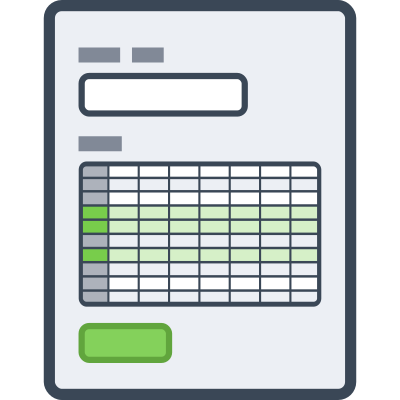
Signed records stay reachable through native Form.io submission IDs and APIs and still export to PDF when the workflow demands it, without forcing a PDF-first process.

Each tenant gets its own form schemas, tenant-scoped submission data, unique API endpoint, and separate auth. Tenant A can never see Tenant B. Form.io enforces the separation at the infrastructure level.

A parent project acts as the template; new tenants are provisioned programmatically from a customer signup. That's the difference between supporting ten customers and supporting ten thousand.

Per-tenant CSS, logos, SMTP, SSO, and file storage mean customers see their own experience. Form.io runs as invisible infrastructure underneath.

Bolt those answers on after the fact and you're stitching together logs that were never designed to agree, or worse, discovering the trail was never kept.
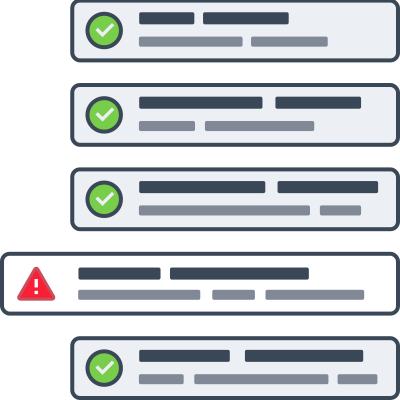
Submission revisions capture every field-level change with the user, timestamp, and a note + fully reversible, nothing destroyed. Server audit logs record every access and authentication event across the system, routable into your existing SIEM.
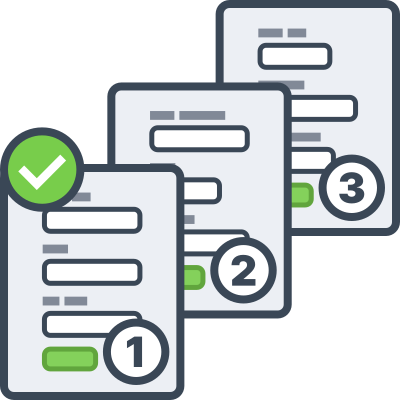
Form revisions keep every published version, and each submission renders against the exact version that captured it so a record from last year never shows up missing or mismatched fields.

Export a submission's complete change history to PDF: revision IDs, who changed what, and when, as a document of record for HIPAA, SOX, FERPA, or FedRAMP review.


Compare Formstack alternatives for Salesforce forms: Form.io vs Formstack on embedded APIs, workflow control, self-hosting, and enterprise form governance.

Compare AI governance platform layers for agentic workflows: Form.io UAG, Appian, Camunda 8.9, Flowable 2025.1, and Microsoft AGT, and where each one governs.
Compare embedded forms and white-label form builders for B2B SaaS teams, from simple embeds to governed APIs, tenant controls, and secure data ownership.
Compare DocuSign alternatives for enterprise form workflows: self-hosted e-signature software, audit trails, APIs, and Form.io E-Sign+ signed-data proof.